
Marine Construction · Since 1998
Waterfront Retaining Walls That Hold Their Line
A retaining wall for a waterfront property takes abuse a backyard wall never will: thousands of pounds of earth behind it, saturated by every rain, frozen and thawed dozens of times a winter — and it can never move. That's what makes a marine retaining wall its own discipline. Behind it is your yard, and above it is often your home.
"The wall is leaning" is one of the most common calls we get. Here's what we tell people: a leaning wall is not a cosmetic problem. It's a wall that has already started to fail, and the timeline from lean to collapse is set by weather you can't control.
Why waterfront retaining walls fail
Almost always: water. Poor drainage lets hydrostatic pressure build behind the wall until something gives. Add Nebraska's freeze-thaw cycles, sandy soils, and spring saturation, and an under-built wall doesn't stand a chance. That's why every wall we build is engineered backwards from drainage — footing, backfill, weep systems, and anchoring matched to the load.
New construction, replacement & repair
We build new waterfront retaining walls, replace failed ones, and — where the structure allows — repair and reinforce walls that are showing early movement. The earlier you call about a lean, the more options (and the smaller the bill).
Marine retaining wall systems we build
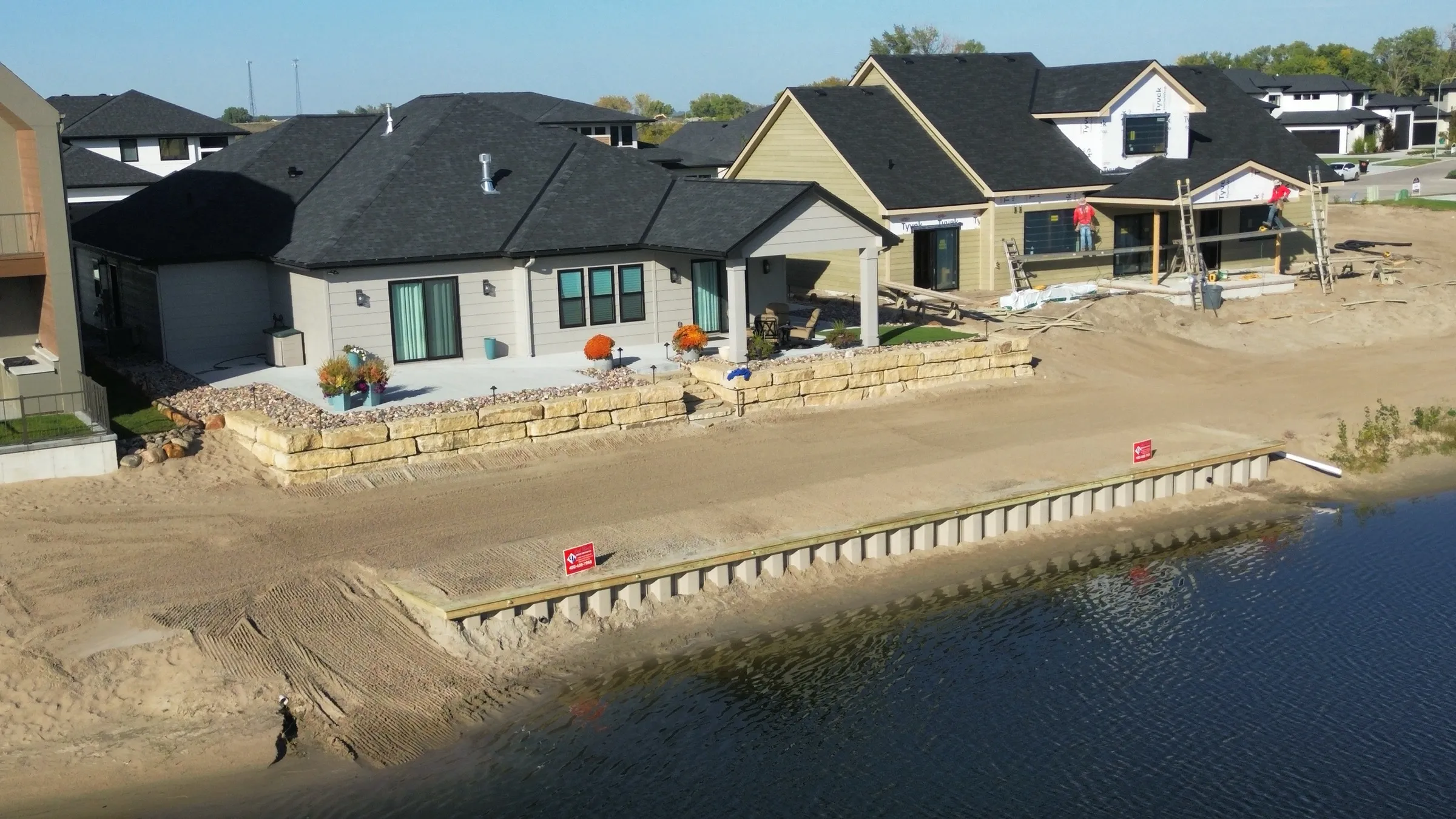
There's no single right wall for the water. The system depends on the wall's height, the soil behind it, how close it sits to the waterline, and the look you're after — so we match it to your site instead of pouring the same wall everywhere. On Southeast Nebraska lakes that's usually segmental block, tiered stone, or armor-stone boulder walls, and every one is engineered backwards from drainage. If the wall sits right at the water's edge, that's seawall territory — a different structure we also build.
Frequently asked questions
What's the difference between a seawall and a retaining wall?
A seawall holds back water at the shoreline; a retaining wall holds back earth up the bank behind or above it. Most waterfront properties need both, and they're engineered differently. If your wall is right at the waterline, that's <a class="ob-link" href="/services/seawalls">seawall work</a>.
How much does a waterfront retaining wall cost?
It depends on the wall's height and length, the system it needs, site access, and how much failed wall has to come out first. We give you a straight number after we walk the shoreline — not a guess over the phone.
My wall is leaning. How urgent is this?
Worth a professional look now, not next year. Some leans are stable for a while; others are one wet spring from letting go. The assessment tells you which you have — and if it can wait, we'll say so.
Can a leaning wall be repaired, or does it have to be replaced?
Depends on cause and construction. Early-stage movement can sometimes be corrected with drainage fixes and reinforcement. Walls that were built without proper footing or drainage usually can't be saved — rebuilding them right is the fix.
Will a new retaining wall increase my property value?
A failing wall absolutely decreases it — it's one of the first things inspectors and buyers flag on waterfront property. A well-built wall protects the value you already have and reads as quality the moment someone sees the lot.
What lake homeowners say
“Matt was very professional and returned all calls in an extremely quick fashion. He did everything he said he was going to do and more. The project turned out better than we could have imagined.”
“Matt and his crew did a very nice job at an affordable price. My seawall was repaired in one day with no damage to my sprinkler lines and minimal damage to my lawn.”
“Matt and his crew did a beautiful job on my seawall. He uses top quality materials, very good at keeping in budget and completed the work as promised in two days.”
If your wall is moving, the clock is running.
Talk directly with Matt — honest answers, no pressure.